

Wondering what it’s like having your wedding in Bali as an Australian? There’s a version that exists in Instagram feeds and Pinterest boards — perfect light, dramatic cliffs, florals that look like they took a week to arrange. That version is real. I photograph it regularly.
But there’s another version that doesn’t get as much airtime. What it’s like having your wedding in Bali as an Australian — from the inside, as the couple. From the moment you land to the moment you’re back at the villa at midnight, slightly stunned that the day you planned for eighteen months is now a memory.
I’ve been photographing weddings in Bali since 2010. The couples I work with are mostly Australian. Over the years, I’ve had enough post-wedding conversations to understand what it’s like having your wedding in Bali as an Australian. I know what the experience delivers, and where it occasionally surprises people.
This is that version.
What Having Your Wedding in Bali Is Like as an Australian
The Week Before Your Wedding in Bali as an Australian
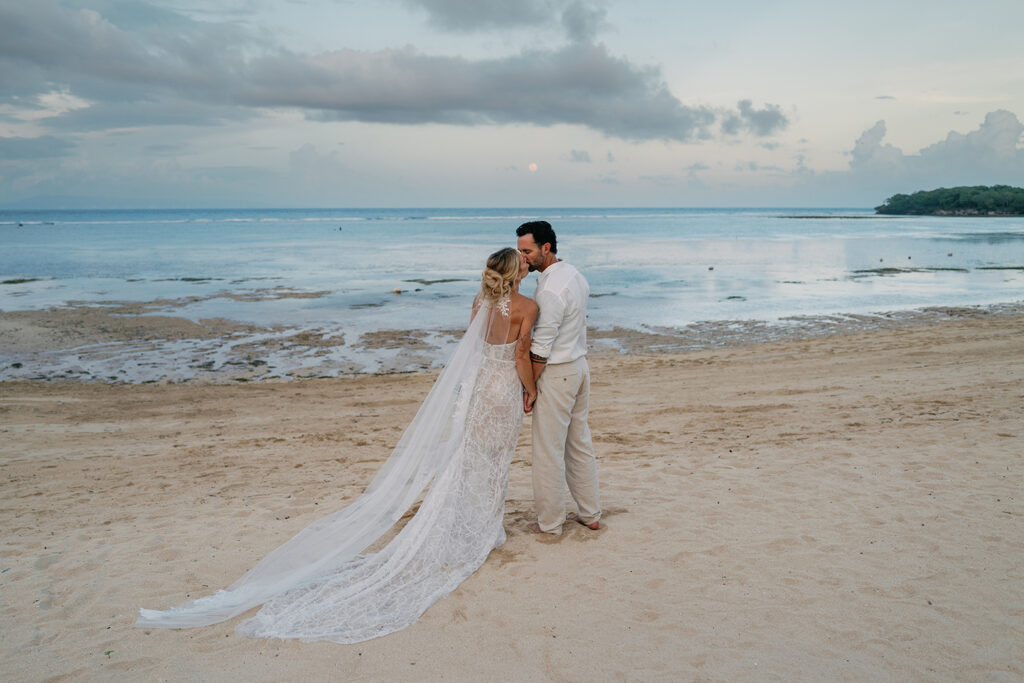
Most Australian couples arrive in Bali three to five days before the wedding
That window is intentional. It gives you time to settle, meet vendors, and let the island decompress you before the day itself.
What catches most couples off guard is how quickly that decompression happens. The pace of life in Bali is genuinely different. The noise drops. The schedule loosens. There’s a quality of attention that emerges when you’re not checking emails about work or running errands between appointments.
By the third day, most couples I work with have stopped talking about logistics and started talking about each other. That shift — from planning mode to presence — is one of the most consistent things I observe. Additionally, it’s one of the things that makes Bali weddings feel different from domestic ones. The destination does some of the work for you.
Lauren and Dan arrived four days before their ceremony at Pandawa Cliff. By the time I met them for a pre-wedding walkthrough, they were relaxed. It’s a calm I don’t often see the day before a wedding. Dan told me they’d barely looked at their phones since landing. That quality of arrival carries into the ceremony itself.
The Morning of the Wedding
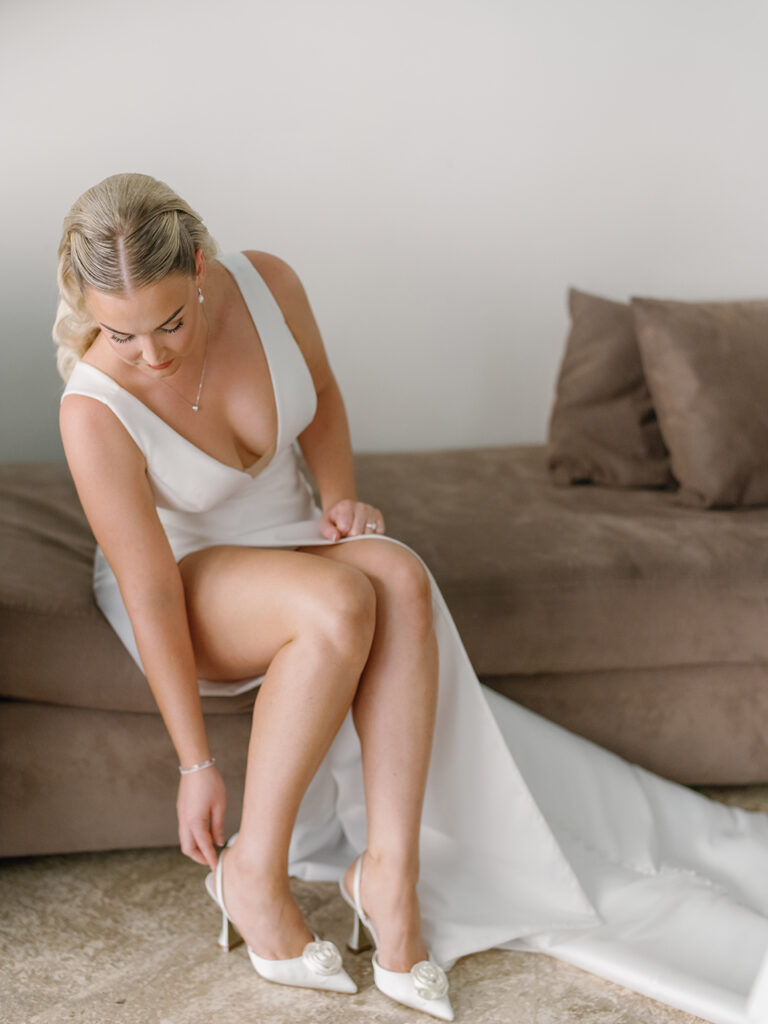
Wedding mornings in Bali have a rhythm that’s become familiar to me after hundreds of them.
The bride’s preparation usually starts early. Hair and makeup typically takes three to four hours for the bride and bridesmaids combined. Most stylists arrive between seven and nine, depending on the ceremony start time. This is when the villa comes alive. There’s music, there’s coffee, and there’s the particular energy of a group of women getting ready together in a beautiful space. The sound of birds and the smell of frangipani come through the open windows.
The groom’s morning is quieter — usually a late breakfast with the groomsmen, a slow walk around the property, and the occasional moment of sitting still that men rarely allow themselves on ordinary days.
What I’ve noticed over the years is that wedding mornings in Bali tend to produce a specific kind of calm. Part of it is the villa environment. Being in a beautiful, private space removes the background noise of home. Furthermore, everyone has already travelled. There’s no last-minute anxiety about who’s running late from across the city. The group is already assembled. The day can begin.
The Ceremony
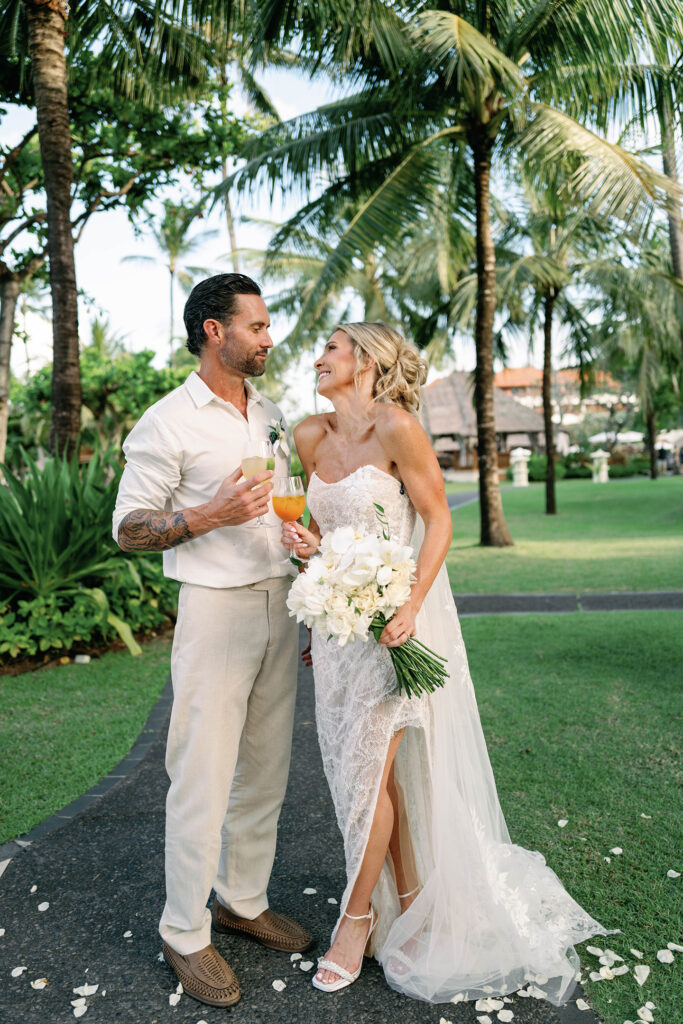
Most Bali ceremonies happen in the late afternoon — typically between four and five-thirty. This is partly practical: the heat of the midday sun makes outdoor standing uncomfortable for guests, and the light in the middle of the day is flat and harsh for photography. However, the late afternoon slot produces something that goes beyond practicality.
By four o’clock in Bali’s dry season, the light has turned. It goes golden and directional, wrapping around faces and clifftop landscapes in a way that requires almost no intervention from a photographer. The temperature drops to something genuinely pleasant. The wind off the ocean carries just enough movement through the scene to make everything feel alive. At clifftop venues, that wind is a constant, welcome presence.
Guests who’ve spent the day at the pool or exploring arrive relaxed and present. There’s none of the mid-morning stiffness of a ten o’clock ceremony, and none of the post-lunch torpor of a two o’clock slot. Four-thirty in Bali, in the dry season, is close to a perfect time for a ceremony. Almost every couple I’ve worked with has said so afterwards.
The Ceremony Itself
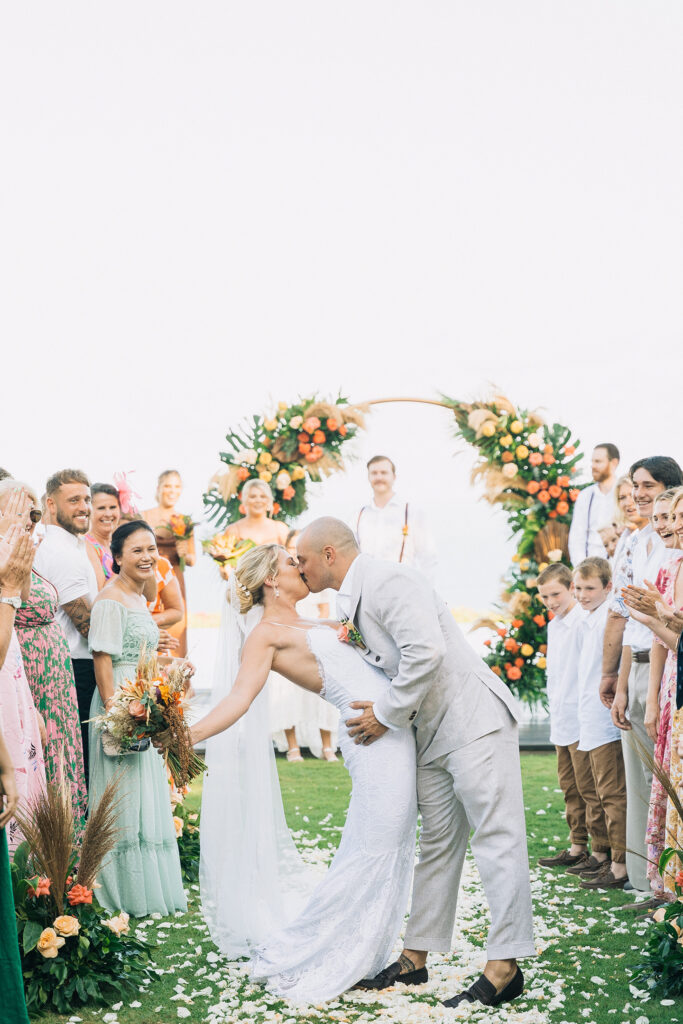
The ceremony itself tends to be more personal than a domestic equivalent. Most Australian couples do a symbolic ceremony with an English-speaking celebrant. Because you’ve chosen that celebrant, the vows tend to be written rather than recited from a template. I’ve watched grown men cry at Bali ceremonies in ways I don’t see as often at home. Something about the distance from ordinary life, the physical beauty of the setting, and the assembled crowd of people who all chose to travel — it makes the moment land differently.
Lauren and Dan’s wedding at Pandawa Cliff is one I think about often. They exchanged vows they’d written themselves. About sixty people had flown from Melbourne to be there. When Dan finished reading his vows, you could hear the ocean below the cliff. Nobody moved. That’s the kind of moment Bali creates more often than coincidence would suggest.
The venues in Uluwatu are purpose-built for this kind of moment — if you’re still exploring your options, our guide to the best wedding venues in Uluwatu Bali covers the properties and what each one actually delivers on the day. And if you want to understand how a documentary photographer approaches a Bali ceremony versus a traditional one, this piece on what it’s like working with a documentary photographer in Bali is the most direct answer I have.
Your Guests: What They Actually Experience
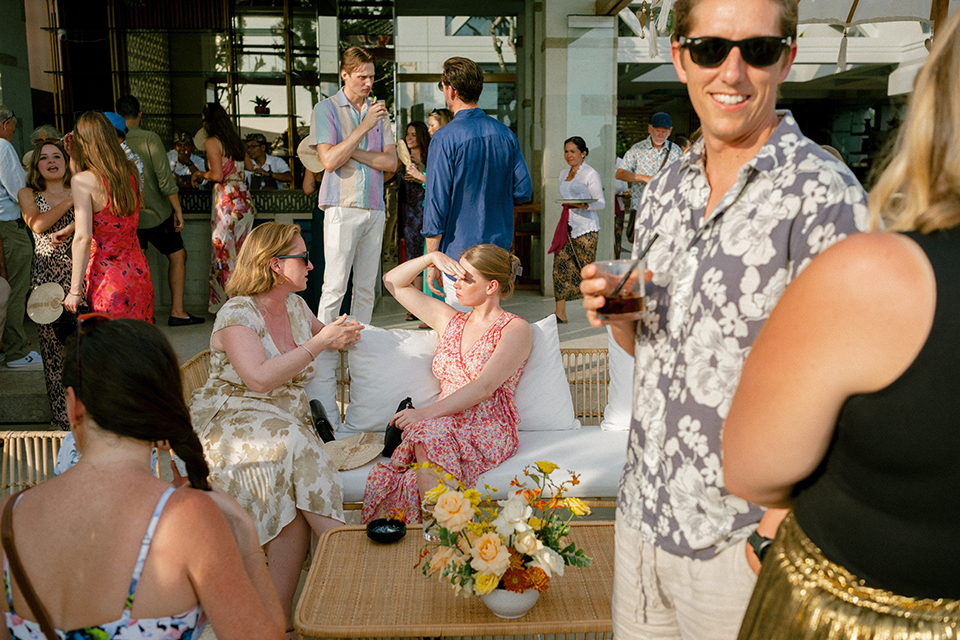
One of the things Australian couples most commonly underestimate is the effect a Bali wedding has on their guests.
At a domestic wedding, guests arrive, celebrate, and go home. It’s a single afternoon or evening, bounded by the ordinary context of their lives. In Bali, however, guests have travelled, which changes everything. They’ve committed to the experience before they arrived. They’ve taken leave from work, booked accommodation, and made plans. By the time they’re sitting in the ceremony, they’re fully there in a way that guests at home rarely manage.
The result is a quality of presence in the room — or on the cliff, or in the garden — that I find genuinely moving to photograph. People are watching. People are feeling it. The phones come out, yes, but there are also just faces turned toward the couple, absorbing what’s happening.
And the celebration doesn’t end with the reception. Guests who’ve travelled are in Bali — they’re going to breakfast together the next morning, exploring Seminyak or Canggu, booking day trips. The wedding becomes the anchor of a shared holiday. The memories extend well beyond the day itself. Couples consistently tell me, months later, that the conversations they had with friends and family in the days around the wedding are some of the most meaningful they’ve had in years.
The Social Dynamic That Bali Creates
There’s also a specific social dynamic that emerges when guests all stay in the same area — or better yet, the same villa complex. People who haven’t spoken in years find themselves by the same pool at ten in the morning. Nobody has anywhere to be. Conversations happen that wouldn’t have happened at a domestic reception where people are watching the clock. Old friendships get renewed. New ones start. Some couples tell me their Bali wedding was the first time their two friendship groups properly met — and those groups have stayed in touch ever since.
Holly and Peter’s guests arrived from across Australia. In the days around the wedding at Wonderland Uluwatu, they explored together — temple visits, dinners in Seminyak, morning swims. The wedding was the centrepiece of something larger, and the photographs from the day show a crowd of people who were genuinely, fully there.
When Things Don’t Go to Plan
I want to be honest about this, because every wedding guide that pretends everything always goes perfectly is doing couples a disservice.
Things go wrong at Bali weddings. They go wrong at every wedding, everywhere. The question is what happens when they do.
At one wedding I photographed, a key floral delivery arrived two hours late. By the time the ceremony started, everything was in place. The couple never knew there had been a problem. Their coordinator had managed the situation, pulled in a backup supplier, and absorbed the entire episode before it could become a source of stress.
That’s what a mature wedding ecosystem looks like. It’s not that problems don’t happen. It’s that the people around you have seen these problems before and know exactly how to handle them. For Australian couples planning ahead, the Australian Government’s Smartraveller website is a useful resource for travel information and advice.
The only things that genuinely disrupt Bali weddings are weather-related. Even those are manageable with the right contingency planning. Wet season weddings require a clear rain plan — a backup indoor space or a venue with good shelter. Dry season weddings carry almost no meaningful weather risk. If you’re planning for May through October and you have an experienced coordinator, the day will run.
The Reception and What Follows
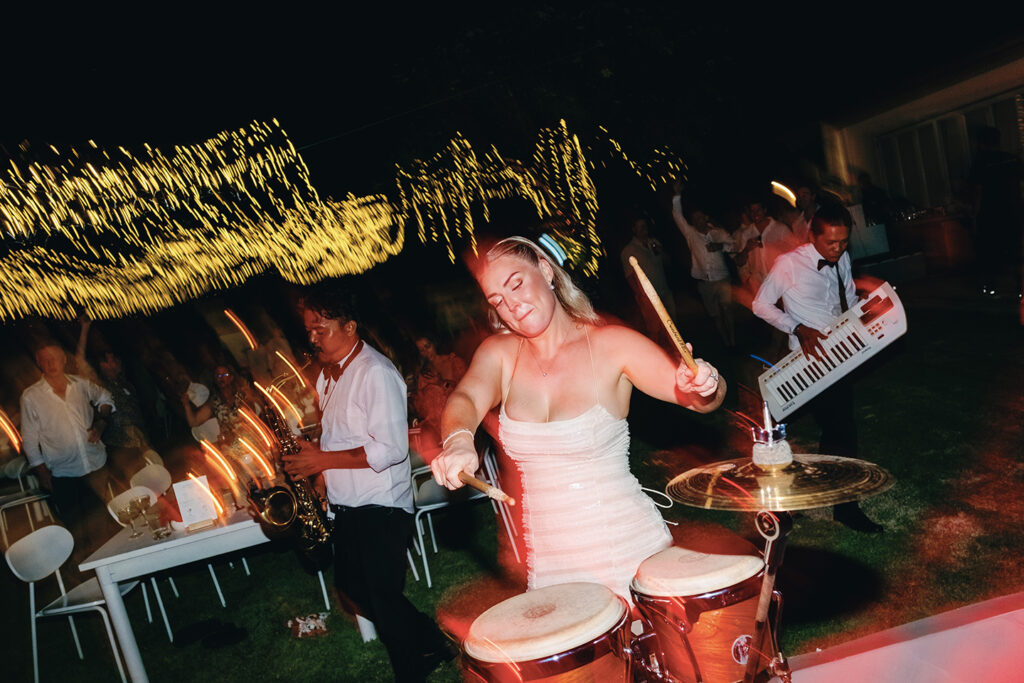
Bali receptions have a particular energy. The group has been through something together — the travel, the week of shared experience, the ceremony. By the time dinner begins, there’s a warmth in the room that builds on itself.
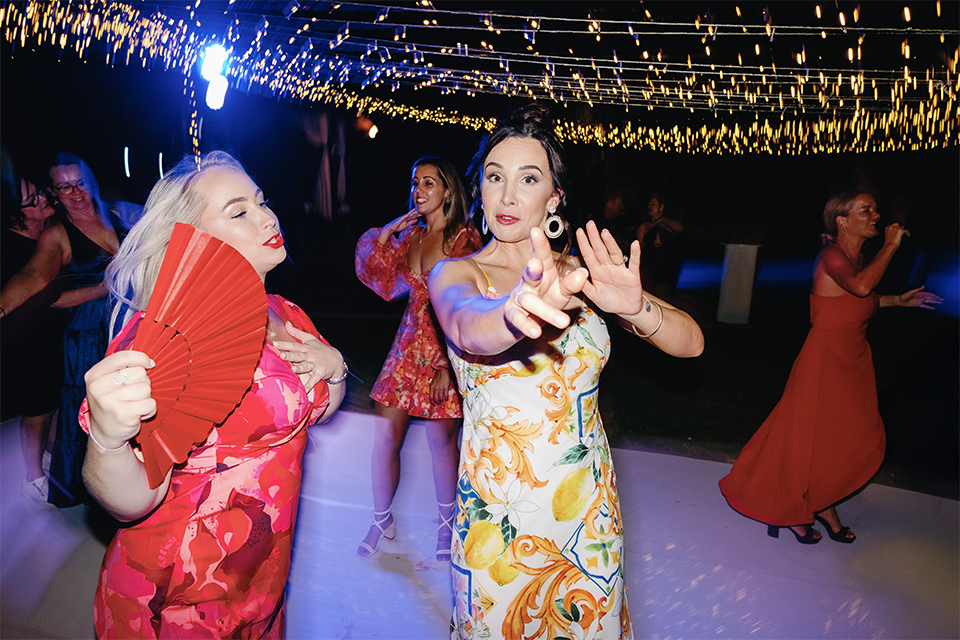
The speeches tend to go longer than planned. People have things to say. The dance floor tends to fill earlier than expected, because everyone is in a holiday mood and nobody has work tomorrow. The night tends to end later than the eleven o’clock venue curfews would suggest. There’s usually an after-party at someone’s villa that continues into the small hours.
What strikes me most, photographically, is what happens in the unplanned moments. A group of guests finding a spot by the pool at the edge of the property. The couple sitting quietly together for five minutes during the reception, away from the crowd, just being. The bride dancing with her father in a moment I wasn’t positioned to photograph perfectly but captured anyway.
Those moments — the unplanned, unrepeatable ones — are what Bali weddings produce in abundance. And they’re what couples mean when they say, months later, that it was everything they hoped it would be.
The Morning After
Most couples I work with describe the morning after their Bali wedding as one of the most peaceful mornings they can remember.
They wake up in their villa, usually to breakfast already being prepared by the villa staff. The guests who stayed on property are moving slowly around the pool. Someone makes coffee. Someone else orders a smoothie. Nobody is in a rush. There’s a collective exhale that happens the morning after a Bali wedding that I don’t think is possible to manufacture — it’s the result of a group of people who all went through something meaningful together and are now simply enjoying being in the same place.
Why the Morning After Is Different
This is, I think, the most distinctive part of what it’s like having your wedding in Bali as an Australian — the part that domestic celebrations can’t replicate. There’s no pack-up, no venue handover, no drive back to the city. The day after is just another day in Bali — beautiful, warm, unhurried — and you’re spending it with the people you love most, who all came here because you asked them to.
For Australian couples whose families don’t often all gather in the same place, this morning-after time carries particular weight. Parents from different states, siblings who haven’t been in the same room for years, old friends who’ve drifted apart — they’re all there, over eggs and coffee, with nothing to do and nowhere to be. Those hours are often what couples remember most vividly months later, more than any specific moment from the day itself.
Jaimee and David spent their morning after at the Nusa Dua Beach Hotel, having breakfast with their closest family before people started heading to the airport. It was quiet and easy. Jaimee told me later that she’d cried over her eggs because she didn’t want it to be over. That response is the mark of a wedding that delivered what it promised.
If you want to see how real Australian couples have experienced their Bali weddings with Luxima, Holly and Peter’s Wonderland Uluwatu wedding and Jaimee and David’s Nusa Dua Beach Hotel wedding both give a clear picture of what the day — and the experience around it — actually looks like.
What Actually Surprises Australian Couples Most
After sixteen years of photographing weddings in Bali, the surprises couples report are remarkably consistent.
The first is how little they actually worried on the day. Most couples arrive at the altar having done the mental work of accepting that not everything will be perfect — and then discover that the day ran more smoothly than they’d dared hope. The coordinator absorbed the problems. The vendors delivered. The timeline held. There’s a relief in that, and it translates directly into how present the couple is during the ceremony and reception.
The second surprise is the vendor quality. Australian couples who have worked with wedding professionals at home sometimes arrive in Bali with mild anxiety about whether the local team will match what they’re used to. What they find, consistently, is that Bali’s experienced vendors operate at a level equal to or better than what they’d have encountered at home — often at a fraction of the cost. If you’re still in the process of choosing your photographer, our guide on how to choose a wedding photographer in Bali covers exactly what to look for — and what to avoid.
The Surprise Most Couples Mention Most
The third surprise is harder to articulate but the most commonly mentioned: the feeling that Bali itself participated in the day. The light arrived at the right moment. The wind moved the dress in a photograph they’ve printed and framed. The particular quality of the air in the late afternoon on a clifftop in Uluwatu was something none of them had experienced before and won’t easily forget.
That last one isn’t something I can plan for as a photographer. However, I’ve watched it happen consistently enough to believe it’s less coincidence than character. Bali is a place that takes ceremony seriously. And somehow, it tends to show up for the couples who choose it.
What It’s Like Having Your Wedding in Bali as an Australian
It’s close to what you imagined, and different in ways you didn’t anticipate. The photographs look like the ones that made you want to do it in the first place. The day runs with more grace than you expected. Your guests are more present than they would have been anywhere else. And the morning after, when you’re sitting by the pool in the quiet, you understand why so many Australian couples make this choice and come back years later to celebrate anniversaries in the same place.
If what you’ve read here sounds like what you’re looking for, take a look at our wedding photography services, explore the best Bali wedding venues for Australian couples to start narrowing down locations, or browse some of the real weddings we’ve photographed to get a sense of what your day could look like.
When you’re ready to start a conversation about your wedding, get in touch here. We’d love to be part of it.


